Why has my sex drive dropped and what actually works to get it back?
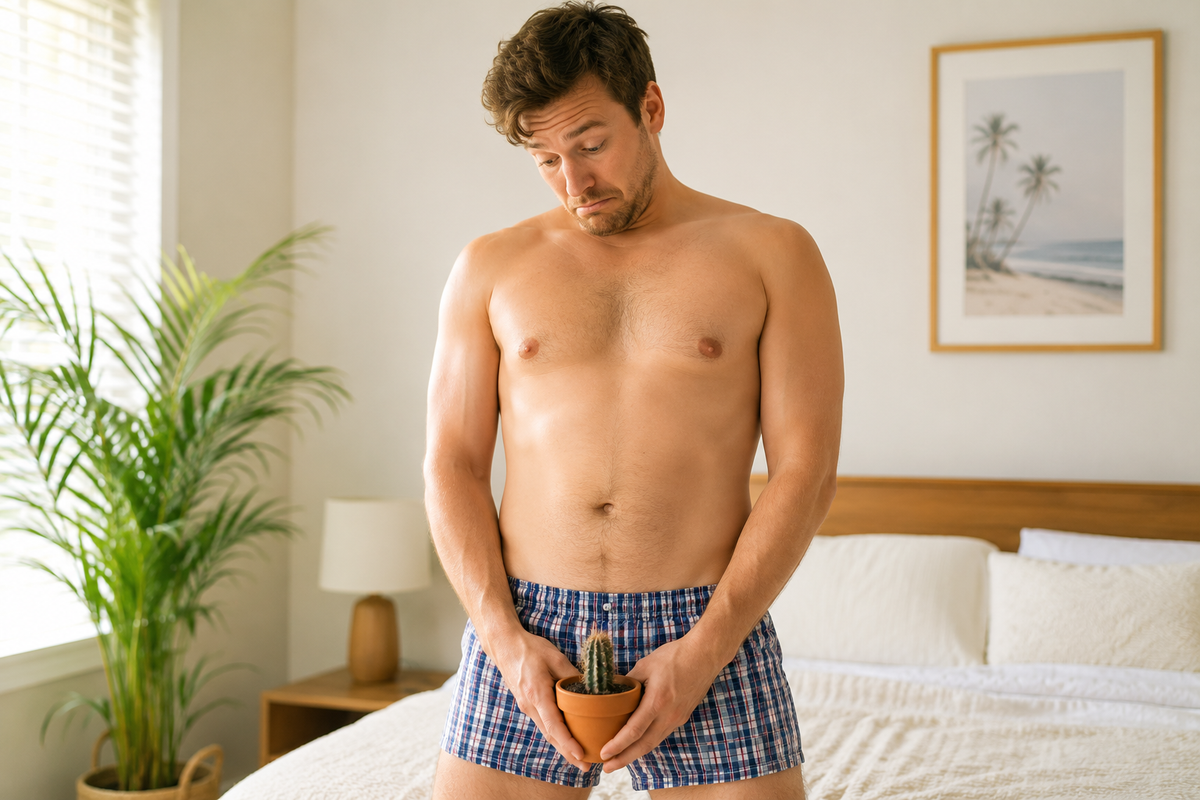
You've stopped initiating. Not consciously. Not as a decision. It just doesn't occur to you the way it used to, and when it does, the thought arrives without any real energy behind it.
Most men at this point reach for one of two explanations: stress, or age.
Both are partially right and almost entirely useless as starting points, because neither tells you where the actual fault is in the system — and without that, anything you try is just guessing.
The standard advice doesn't help. "Sleep more, stress less, work out" feels useless to a man who has a job that doesn't pause, children who don't care about his cortisol levels, and a relationship where the distance is already noticeable enough that nobody's talking about it directly.
The supplement industry fills the gap with testosterone boosters, most of which are built around ingredients — Tribulus terrestris, ZMA, D-aspartic acid — that either don't move the needle on hormone levels meaningfully or produce effects so brief and modest they're not worth the price.
The TRT clinics fill the rest with the promise that a gel or an injection will restore what you had at 27. What they don't lead with is that raising your testosterone number and raising your libido are two different things. One man's experiment with testosterone injections that more than doubled his levels produced no improvement in desire whatsoever. Not a small improvement. None. The number went up. The experience didn't change.
The reason that happens gets us to the concept that makes this whole thing legible.
Your libido is not a testosterone level
Lets say that one more time. Your libido is not a testosterone level!
It is the output of a hormonal signalling chain that runs from your hypothalamus down through your pituitary gland and into your testes. The hypothalamus releases GnRH, which tells the pituitary to release LH and FSH, which tells the testes to produce testosterone. When you inject exogenous testosterone, you interrupt that chain via negative feedback — the brain sees high testosterone and stops signalling. LH drops. The pathway goes quiet. You have more testosterone in your blood and less of the upstream signalling that appears to drive desire independently of the testosterone it produces. This is the axis. When libido drops, something in the axis is failing — and where the failure is determines what will actually fix it.
Simply put: you can have more testosterone in your blood, but less of the natural signalling that helps drive desire.
Get the right blood work before you do anything else
Total testosterone alone is close to useless as a diagnostic. What you need is a full panel: total testosterone, free testosterone, LH, FSH, estradiol, and SHBG — sex-hormone binding globulin.
SHBG is the protein that latches onto testosterone and renders it biologically inactive. A man can have perfectly normal total testosterone and have a third of it neutralised by elevated SHBG, leaving his free testosterone — the fraction that actually does anything — significantly low.
Strict low-fat or low-cholesterol diets are a documented SHBG elevator; research has shown they can reduce free testosterone by up to 18% through this mechanism alone. If LH is low, the problem may sit at the pituitary level rather than the testes. If free testosterone is low despite normal total, SHBG is the likely culprit. The blood work tells you which part of the axis to address. Without it, everything downstream is guesswork.
Request the full panel from your GP or a men's health clinic, and retest after any intervention you make.
Fix the dietary pattern that is suppressing your free testosterone
If your diet has drifted toward very low fat, whether through health-consciousness or circumstance, the intervention is specific. Reintroduce dietary fat, particularly from cholesterol-rich whole food sources like eggs, red meat, and full-fat dairy.
The body uses cholesterol as a precursor to testosterone synthesis, and there is a reasonable mechanistic case for including cholesterol-rich food in the evening, when most endogenous testosterone production occurs overnight.
Shift toward a higher-protein, moderate-fat dietary pattern. This is not a macro overhaul. It is removing a specific suppressor. Retest your SHBG and free testosterone after eight to twelve weeks of consistent dietary change before drawing conclusions.
Treat sleep as hormonal medicine, not recovery
Sleep deprivation chronically activates the sympathetic nervous system, i.e. the fight-or-flight state, which sustains elevated cortisol (your stress hormone).
Cortisol and testosterone are downstream competitors for the same hormonal precursor pathways; when cortisol stays high, testosterone production tends to stay low. The mechanism is direct, not metaphorical.
Disrupted sleep also suppresses growth hormone release, which occurs primarily in the first hours of deep sleep and which plays a role in overall hormonal health.
The protocol here is not "sleep more."
It is a fixed wake time seven days a week regardless of the previous night, no screens or work email after 9:30pm, and no high-intensity training within three hours of bed.
Consistent sleep onset is the primary driver of sleep quality — not duration alone. Run this for four weeks and notice whether desire begins to return before you attribute anything to other interventions.
Address micronutrient deficiencies before spending money on anything else
Vitamin D deficiency is common in northern latitudes and in men who spend most daylight hours indoors, and there is solid mechanistic evidence linking it to testosterone production. Zinc deficiency measurably suppresses testosterone. Magnesium is involved in hundreds of enzymatic processes including those that regulate SHBG.
Get a blood panel that includes vitamin D and zinc. If you are deficient, correct it: 2,000–4,000 IU of vitamin D3 daily with food, 25–30mg of zinc picolinate daily, and 300–400mg of magnesium glycinate before bed.
These are not performance enhancers in a man with healthy levels — they are corrections of deficiencies that are silently suppressing a system that is trying to function. Supplementing into excess does not improve on adequate, so test before you dose.
Reduce stress through deliberate recovery windows
Reduce your cortisol load through deliberate recovery windows, not stress management content. Cortisol suppression of the HPG axis is cumulative and sustained.
In practice this means two 20-minute phone-free breaks per day — one before noon, one before 5pm — with no task switching into either window, creates measurable parasympathetic recovery time.
This is not meditation.
Sit outside, eat without a screen, walk without headphones.
The mechanism is simply interrupting the continuous sympathetic activation that keeps cortisol elevated. If this sounds too small to matter, run it for three weeks before dismissing it.
Men in chronic stress tend to underestimate how little true rest they are actually getting across a day.
One honest limit
If your libido has dropped significantly and none of these interventions produce any change after twelve weeks of genuine application, the issue may not be hormonal at all.
Relationship emotional disconnection: the drift that accumulates quietly over years, suppresses desire in ways that no hormone panel will reveal and no supplement will address.
That conversation is harder and belongs in a different article. But it is worth knowing before you spend three months and several hundred dollars optimising an axis that isn't actually the problem.
Tomorrow morning: book the blood panel.
Total testosterone, free testosterone, LH, FSH, estradiol, SHBG, vitamin D, zinc. Everything else waits until you know where the axis is actually failing.